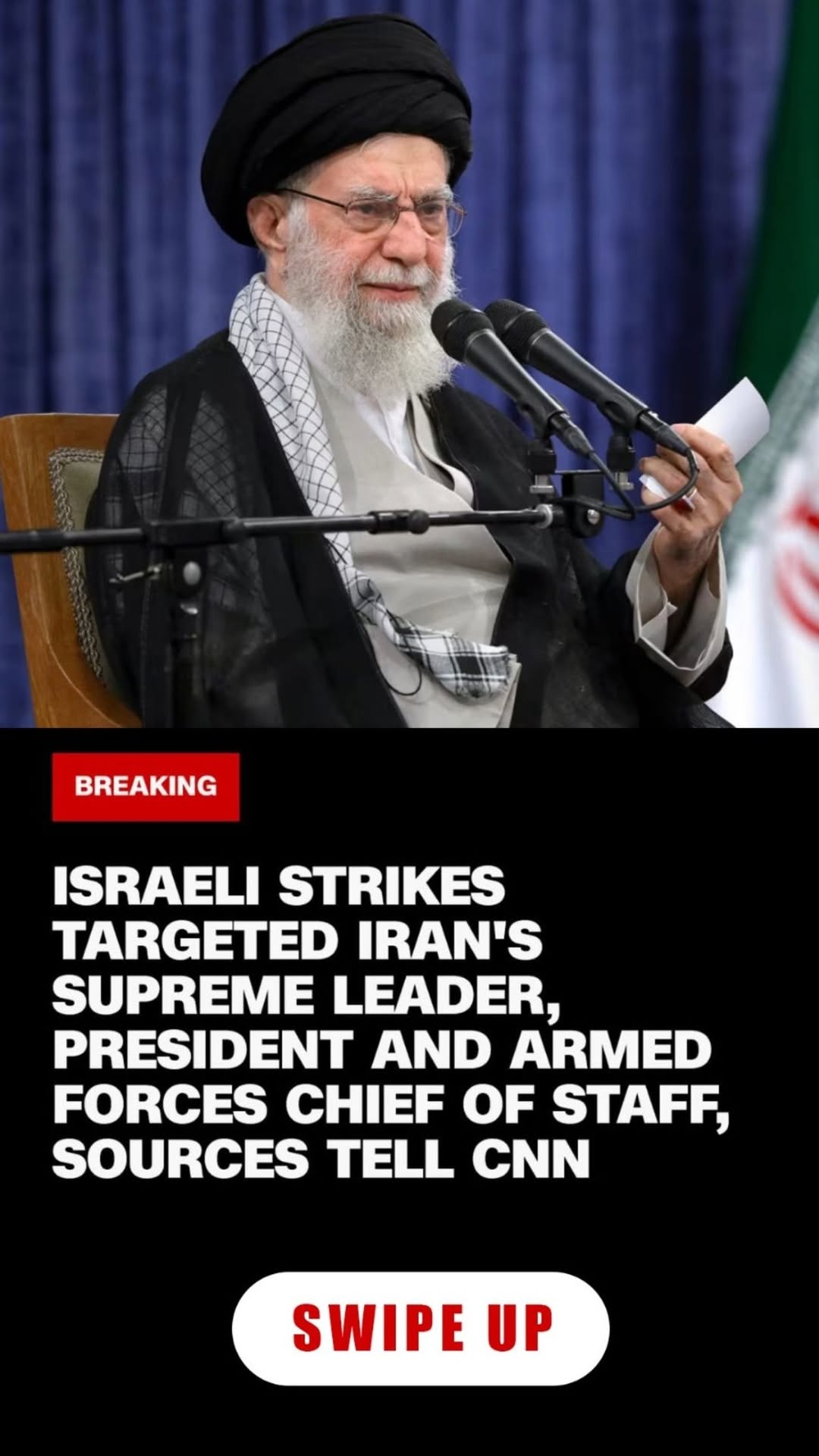
Iran’s supreme leader killed in strikes, Israeli sources say
President Donald Trump has called for regime change following the massive US and Israeli attack, which prompted an unprecedented wave of retaliatory strikes by Iran.

Where things stand now
• JUST IN: Supreme Leader Ayatollah Ali Khamenei was killed in today’s massive US and Israeli strikes on Iran, according to Israeli sources. The news comes shortly after Iran claimed its leaders were “safe and sound.”
• About the attack: US President Donald Trump has indicated the ongoing military operation is aimed overturning Tehran’s government. More than 200 people have been killed in Iran, according to state media.
• Unprecedented retaliation: Iran unleashed strikes on US military bases, Israel and other targets across the Middle East, rocking densely populated areas and disrupting air travel and oil shipments.
• Latest from the US: The military has reported no combat-related American casualties. FBI counterterrorism teams are on high alert, and the State Department advised US citizens around the world to “exercise increased caution.”
A region on edge: The United Arab Emirates called the conflict a “historic moment” in the Middle East, saying world leaders had failed to ensure the region’s stability.
Israel has confirmed Iran’s supreme leader killed in strikes, Israeli sources say
Iran’s Supreme Leader Ayatollah Ali Khamenei speaks during a meeting in Tehran, Iran, May 20, 2025.
Iran’s Supreme Leader Ayatollah Ali Khamenei speaks during a meeting in Tehran, Iran, May 20, 2025. Office of the Iranian Supreme Leader/Wana News Agency/Reuters
Israel has confirmed that Iran’s supreme leader was killed in strikes on Saturday, according to two Israeli sources familiar with the matter.
One of the sources said Israel had obtained a photo of Ayatollah Ali Khamenei’s dead body. The second source said an official announcement is being prepared.
Earlier in the evening, Prime Minister Benjamin Netanyahu said there are many signs that Khamenei is “no longer with us.”
Meanwhile, the Iranian Foreign Ministry spokesman said that Iran’s president and Supreme Leader are “safe and sound.” But Khamenei has not been seen in public or in videos since the strikes began.
Holy sites in Jerusalem closed to worshippers, Israeli police say

A view of Jerusalem with an empty Al-Aqsa Mosque compound on Saturday, as a faint rocket trail from Israel’s Iron Dome missile defense system is seen at the left, on the horizon. Ahmad Gharabli/AFP/Getty Images
Holy sites in Jerusalem are closed to worshippers as a safety measure, Israeli police said in a statement Saturday.
“Jerusalem District police officers and Border Police forces have been deployed in reinforced and extensive formations since the early morning hours across all areas of Jerusalem, and in the Old City in particular, in order to safeguard public security,” according to a release from the Police Spokesperson’s Unit.
As the holiest city in Judaism and Christianity, and the third-holiest in Islam, the ban includes many important sites.
A 24-hour webcam aimed at the Western Wall shows its plaza completely deserted as of 9:30 p.m. local time. Likewise, the ban precludes any gatherings at the adjacent Al-Aqsa Mosque, shuttering the holiest site for Muslims in city in the midst of Ramadan.
Trump attacked Iran after negotiations devolved into “games, tricks, stall tastics,” senior official says
President Donald Trump decided to strike Iran after concluding that its leadership was unwilling to abandon its pursuit of nuclear enrichment, a senior administration official said today.
“It was clear that the intent for them was to preserve their ability to do enrichment so that, over time, they could use it for a nuclear bomb,” the official told reporters. “We could have made another short-term, bad deal, but it wouldn’t have dealt with the long-term issue.”
Trump had dispatched Steve Witkoff and his son-in-law, Jared Kushner, as envoys for negotiations with Iran in the weeks leading up to today’s early-morning strikes. But the talks stalled, with the president saying repeatedly on Friday that he was “not happy” with their trajectory.
The administration had offered Iranian leaders options for developing what the senior official called a “peaceful nuclear program.”
“We offered them many, many ways to do that,” the senior official said. “But instead, that was met with games, tricks, stall tactics, and that was really the conclusion that we came back with.”
Here’s a recap of our most recent headlines if you’re just joining us

Rubble remains in the aftermath of an Israeli-U.S. strike in Tehran, Iran, on Saturday. Amir Kholousi/AP
News continues to roll in from the Middle East as Iran retaliates to strikes from the US and Israel.
With the situation still evolving rapidly, here’s a quick overview of our latest headlines:
- Israel’s prime minister said there are signs Iran’s supreme leader is “no longer with us” after the attacks, though Tehran is refuting that claim, with a foreign ministy spokesperson insisting both the supreme leader and Iranian president are “safe and sound.”
- More than 200 people have died as a result of the US-Israeli strikes, according to Iranian state media Press TV, which cited the Iranian Red Crescent.
- The US hasn’t suffered any combat-related casualties in its operation, US Central Command said in a statement. Damage to US installations has been minimal and hasn’t affected operations, CENTCOM said.
- Iranian armed forces operations “will continue with even greater force,” a military spokesperson said in a video message. Iran intends to continue its retaliatory offensive “until the aggressor is punished,” an Iranian source with knowledge of the country’s military strategy tells CNN.
- The FBI’s counterterrorism and counterintelligence teams are on elevated alert nationwide, a bureau official told CNN, and the State Department advised US citizens around the world to “exercise increased caution.”
- The US and Israel’s attack generated immediate unease among close allies in the MAGA base, who expressed fears that the strikes could drag the US into yet another prolonged entanglement in the Middle East. President Donald Trump had previously vowed to avoid regime-change efforts in Iran.
- Some oil tankers have U-turned to avoid sailing through the Strait of Hormuz — the critical channel between Iran’s southern coast and the northern tip of Oman — according to the latest tracking data from the analytics firm Kpler.
- Israel dropped hundreds of munitions against approximately 500 targets as part of the massive wave of strikes, the Israeli military said.